LES DISPARITIONS
Ink and water
In the Disappearances series, figures do not truly vanish. They gradually decompose and simplify as forms, shadows, and light are reduced to their essential relationships. Bodies remain present, yet their boundaries become uncertain, suspended between emergence and dissolution. Light plays a central role in this process. Detached from its descriptive function, it acquires an almost material presence, sometimes appearing more stable than the figures themselves. Shadows dissolve, contours blur, and individuals merge into a shared visual field where singular identities become fragile. Rather than representing absence, these drawings explore transformation. Figures persist through their own alteration, occupying an unstable space between visibility and disappearance.
What remains is not the image of a loss, but the trace of a continuing presence.
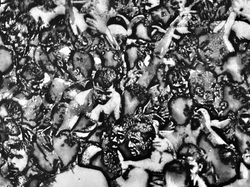 Disparitions 8ink and water on cardboard 80x60 2026 |  Disparitions 9Ink on cardboard 90 x 80 2026 |
|---|---|
 Disparitions 3ink and water on cardboard 80x50 2025 |  Disparitions 1ink and water on cardboard 80x60 2025 |
 Disparitions 6ink on cardboard 75 x 60 cm 2025 |  Disparitions 5ink and water on cardboard 80x60 2025 |
 Disparition 5détails |  Disparitions 4ink and water on cardboard 80x60 2025 |
 Disparitions 4détails |  Disparitions 2ink and water on cardboard 80x60 2025 |

DÉLUGES
Ink and water
The Déluge series (floods) explores the city as a state of transition. Urban landscapes appear suspended between construction and collapse, permanence and transformation. Marked by the aftermath of a dramatic event, these environments occupy an uncertain condition in which the future of forms remains unresolved.
Neither fully intact nor entirely destroyed, they bear the visible traces of forces that have profoundly altered their structure and meaning.
Created with ink, the drawings are shaped by processes of dilution, flow, and accumulation. Shadows spread across the surface like moving currents, while areas of light emerge as fragile structures that sustain the image. Suspended within the composition, these luminous forms seem to hold the city together, resisting collapse while revealing its vulnerability.
Architecture becomes permeable, exposed to forces that erode, alter, and redefine its presence. Throughout the series, the movement of the tide serves as an underlying principle. Like a recurring ebb and flow, forms emerge, recede, and reappear in altered states. The city is not represented as a fixed structure but as a shifting landscape, continuously reshaped by forces of transformation. The fluidity of ink echoes both the movement of water and the unstable memory of a traumatic upheaval whose effects continue to reverberate through the urban fabric. The works maintain an ambiguity between the aftermath of natural catastrophe and the traces of human conflict.
 Déluge 11Ink and water on cardboard 80x60 2025 |  Déluge 10Ink and water on cardboard 90x70 2025 |
|---|---|
 Déluge 9Ink and water on cardboard 90x70 2025 |  Déluge 12Ink and water on cardboard 90x70 2025 |
 deluge 8ink and water on cardboard 90 x 70 2025 | 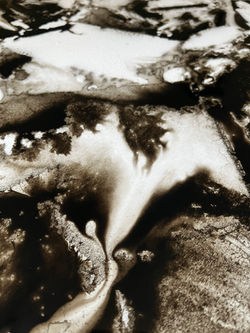 Délugesdétails |
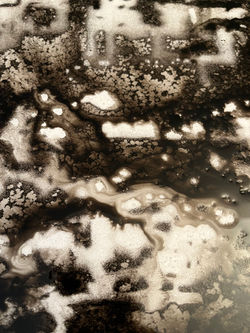 Délugesdétails |
 Déluge 7ink and water on cardboard 80x60 2025 |
|---|


The Dust series is created with charcoal powder, a material born of fire and combustion. As both medium and residue, charcoal carries the memory of transformation within its very substance. Neither fully solid nor entirely dispersed, it occupies an unstable state between persistence and disappearance. The drawings depict war-damaged ruins fragmented by time and conflict. Buildings appear suspended between collapse and survival, emerging from accumulations of powder only to dissolve back into the surface. The material itself mirrors the condition of the structures it represents: fragile, unstable, and continually threatened by dispersal. Throughout the series, dust functions as a form of material memory.
The scattered particles evoke the fragmentation of cities marked by war, while their accumulation suggests the persistence of traces despite destruction. Yet as architecture collapses and identities fade, cities gradually lose their singular features. Beirut, Aleppo, Mariupol, or any other devastated city become increasingly difficult to distinguish. Their histories remain, but their forms return to a common mineral condition, as if architecture itself were reverting to its original matter. Beneath cultural, political, and historical differences lies a shared substance to which all cities ultimately return. The drawing becomes a fragile archive where memory settles, erodes, and reforms. Silence inhabits these spaces, replacing the violence that produced them and allowing the trace to become visible. In this return to dust, destruction paradoxically reveals a shared condition. Echoing the ancient notion that all things ultimately return to dust, the series approaches ruin not only as a consequence of war but also as a return to a primordial state. Dust becomes both an ending and a beginning: the point at which architecture relinquishes its identity and rejoins the mineral world from which it emerged.
Ruins reduce cities to a common condition in which individual identities dissolve into a collective experience of loss, transformation, and persistence. Rather than presenting ruin as a final condition, Dust explores the threshold between disappearance and survival.
 Poussières 4Black powder on cardboard 80x60 2025 |  Poussières 12Black powder on cardboard 80x60 2025 |
|---|---|
 Poussières 6Black powder on cardboard 80x60 2025 |  Poussières 7Black powder on cardboard 80x60 2025 |
 Poussieres 1Black powder on cardboard 80x60 2025 |  Poussières 2Black powder on cardboard 80x60 2025 |
 poussieres 10Black powder on cardboard 80x60 2024 |
 Poussières 9black powder on cardboard 80 x 60 cm 2024 |  Poussières 3black powder on cardboard 80 x 60 cm, 2024 |
|---|---|
 Poussières 8black powder on cardboard 80 x 60 cm 2024 | 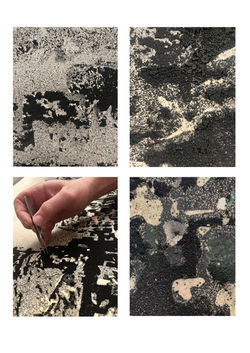 |
 |


